
Hokuto no Ken (1986 movie): Difference between revisions
No edit summary |
No edit summary |
||
| (10 intermediate revisions by 4 users not shown) | |||
| Line 1: | Line 1: | ||
{{Infobox film | {{Infobox film | ||
| name = Fist of the North Star | | name = Fist of the North Star | ||
| image = [[Image:Hokuto no Ken (1986 movie pamphlet).jpg]] | | image = [[Image:Hokuto no Ken (1986 movie pamphlet).jpg|350x350px]] | ||
| caption = Theatrical pamphlet distributed in 1986 | | caption = Theatrical pamphlet distributed in 1986 | ||
| director = [[Toyoo Ashida]] | | director = [[Toyoo Ashida]] | ||
| Line 31: | Line 31: | ||
==Alternate versions== | ==Alternate versions== | ||
===Endings=== | ===Endings=== | ||
There were two endings produced for the film. The original ending shown in the theatrical version has Raoh emerging victorious over Kenshiro, but sparing his life, leaving him to protect Lin. An alternate ending was produced that end the fight in a draw, which is the ending featured in | There were two endings produced for the film. The original ending shown in the theatrical version has Raoh emerging victorious over Kenshiro, but sparing his life, leaving him to protect Lin. An alternate ending was produced that end the fight in a draw, which is the ending featured in the VHS and Laserdisc releases of the film in Japan (although, the 1995 film comic adaptation depicts the original ending). All the international cuts feature the original ending. The reason for the change in ending has never been officially revealed, although it is believed that fans were unsatisfied with Kenshiro losing the final fight. | ||
The 2008 Japanese DVD release of the film features the theatrical ending as a bonus feature, but only on the first print run. Because the revised ending was produced on a different film stock, it did not | The 2008 Japanese DVD release of the film features the theatrical ending as a bonus feature, but only on the first print run. Because the revised ending was produced on a different film stock, it did not undergo the same remastering treatment that the rest of the movie did (including the original ending), resulting in a drastic drop in visual quality when the scene is played (on the 1:40:45 time mark). | ||
Another change in the ending made in the home video versions was the addition of a black title card with the kanji 完 (''kan'') for "The End" after the closing credits. Reportedly this title card was not present in the a theatrical version and was only added on the home video releases after plans for a sequel were abandoned. | Another change in the ending made in the home video versions was the addition of a black title card with the kanji 完 (''kan'') for "The End" after the closing credits. Reportedly this title card was not present in the a theatrical version and was only added on the home video releases after plans for a sequel were abandoned. | ||
<div class="thumb tright"> </div> | <div class="thumb tright"> </div> | ||
===Censorship=== | ===Censorship=== | ||
| Line 45: | Line 44: | ||
[[File:Hokuto No Ken Movie - Uncut scenes from the Italian VHS (High Quality)|thumb|425x425px]] | [[File:Hokuto No Ken Movie - Uncut scenes from the Italian VHS (High Quality)|thumb|425x425px]] | ||
</div> | </div> | ||
A number of the film's violent scenes, particularly those involving close-ups of human decapitations and butchering, were toned down through the use of discoloration or a rainbow blurring effect in most versions of the film including the original Japanese release. This is evident in one of the preview trailers, which features a shot of Rei slicing the head of one of Fox's henchmen without the blur. | |||
* The scene when Shin engraves the seven wounds on Kenshiro's chest (as well as the later flashback of the same scene when Kenshiro is resting in Lin's village) has no discoloration when Shin is making the wounds with his fingers. There's also no blur in the shot when Shin lifts his bloodied finger next to his face. | |||
Currently, no fully uncensored version of the film has ever been released and it's not known for certain if an uncensored version was ever shown in theaters. However, the Italian dubbed version, released on VHS in 1993 by Granata Press and re-released in 1996 by Dynamic Italia, included a select few scenes unedited: | |||
* The scene when Shin engraves the seven wounds on Kenshiro's chest (as well as the later flashback of the same scene when Kenshiro is resting in Lin's village) has no discoloration when Shin is making the wounds with his fingers. There's also no cloudy blur in the shot when Shin lifts his bloodied finger next to his face. | |||
* The scene in which one of Zeed's underlings explodes in front of Bat, spilling blood on his face, has no discoloration. | * The scene in which one of Zeed's underlings explodes in front of Bat, spilling blood on his face, has no discoloration. | ||
* When Raoh's army is marching into the city of Cassandra, there's short scene in which Galf crushes the head of a villager whose chanting is off-key. In the censored version, it cuts to a shot of Raoh's army just when Galf grabs the villager's head and then cuts back to Galf after the villager's body falls to the ground. This is notable for being the only known scene that was outright edited from the movie rather than being blurred out. | * When Raoh's army is marching into the city of Cassandra, there's short scene in which Galf crushes the head of a villager whose chanting is off-key. In the censored version, it cuts to a shot of Raoh's army just when Galf grabs the villager's head and then cuts back to Galf after the villager's body falls to the ground. This is notable for being the only known scene that was outright edited from the movie rather than being blurred out. | ||
| Line 139: | Line 140: | ||
==Techniques featured== | ==Techniques featured== | ||
*Shin: '''[[Nanto Gokuto Ken|Nanto Gokusatsu Ken]]''' | |||
*Jagi: '''[[Hokuto Rakan Geki]]''' | |||
*Kiba Daioh: '''[[Kazan Kogai Koho]]''' | |||
*Uighur: '''[[Taizan-ryu Senjo Ben]]''' | |||
*Kenshiro/Raoh: '''[[Hokuto Shichishi Toki Dan]]''': This technique was named in the trailer. | |||
===Pressure points=== | ===Pressure points=== | ||
*''' | *'''Kyosetsu''' ({{ruby|拒節|きょせつ}}) - Used on Jagi. Note that this was named in this movie. | ||
==Trivia== | ==Trivia== | ||
| Line 147: | Line 153: | ||
* [[Heart|Mr. Heart]] is referred by the name "Elephant" (エレファント) on the character model sheets and early promotional materials.<ref>{{cite web|url=http://razorsharp.blog.fc2.com/blog-entry-442.html|title=「北斗の拳」で美しいと言えば… (Razor Sharp)}}</ref> This planned name change was presumably done to go along with the animal motif of [[Fox]] and [[Jackal]], who were rewritten to be [[Jagi]]'s henchmen along with Heart. However, he retains his original name in the finalized film. | * [[Heart|Mr. Heart]] is referred by the name "Elephant" (エレファント) on the character model sheets and early promotional materials.<ref>{{cite web|url=http://razorsharp.blog.fc2.com/blog-entry-442.html|title=「北斗の拳」で美しいと言えば… (Razor Sharp)}}</ref> This planned name change was presumably done to go along with the animal motif of [[Fox]] and [[Jackal]], who were rewritten to be [[Jagi]]'s henchmen along with Heart. However, he retains his original name in the finalized film. | ||
* The February 3, 1986 issue of ''Weekly Jump'' (issue no.8 of 1986) features a preview of the movie on the other side of [[HnK Chapter 118|the issue's ''Hokuto no Ken'' spread]].<ref>{{cite web|url=http://ameblo.jp/neo-izayoi-onepiece/entry-12191323205.html|title=【ジャンプ黄金期】1986年『第8号』2月3日号}}</ref> The preview lists a slightly different lineup of matches compared to the ones actually featured in the actual movie. Most notably it lists the third match as "[[Kenshiro]] vs. [[Devil Rebirth]]", the latter being a character who is not in the movie. Other matches not in the final movie include "[[Shin]] vs. [[Raoh]]" (the actual fight is alluded in the movie, but only the outcome is shown), "[[Rei]] vs. [[Kiba Daiō]]" and "Kenshiro vs. [[Uighur]]".<ref>{{cite web|url=http://kitayama3800.publog.jp/archives/25203611.html|title=劇場版 北斗の拳のパンフレットを入手!! you は shock}}</ref> | * The February 3, 1986 issue of ''Weekly Jump'' (issue no.8 of 1986) features a preview of the movie on the other side of [[HnK Chapter 118|the issue's ''Hokuto no Ken'' spread]].<ref>{{cite web|url=http://ameblo.jp/neo-izayoi-onepiece/entry-12191323205.html|title=【ジャンプ黄金期】1986年『第8号』2月3日号}}</ref> The preview lists a slightly different lineup of matches compared to the ones actually featured in the actual movie. Most notably it lists the third match as "[[Kenshiro]] vs. [[Devil Rebirth]]", the latter being a character who is not in the movie. Other matches not in the final movie include "[[Shin]] vs. [[Raoh]]" (the actual fight is alluded in the movie, but only the outcome is shown), "[[Rei]] vs. [[Kiba Daiō]]" and "Kenshiro vs. [[Uighur]]".<ref>{{cite web|url=http://kitayama3800.publog.jp/archives/25203611.html|title=劇場版 北斗の拳のパンフレットを入手!! you は shock}}</ref> | ||
*Along with a few Hokuto no Ken digest tapes releases, the film is one of the few medias to feature | *The film was released in Dolby Stereo. Along with a few Hokuto no Ken digest tapes releases, the film is one of the few medias to feature stereo audio. | ||
==Gallery== | ==Gallery== | ||
| Line 165: | Line 171: | ||
Image:Peasant.jpg|va [[Yasuo Tanaka]] | Image:Peasant.jpg|va [[Yasuo Tanaka]] | ||
Image:Galf Crush.jpg|va [[Jōji Yanami]] | Image:Galf Crush.jpg|va [[Jōji Yanami]] | ||
Image:D.jpg|[ | Image:D.jpg|[[w:c:vampirehunterd:D|Vampire Hunter D]] | ||
Image:Arion.jpg|[[wikipedia:Arion (manga)|Arion]] | Image:Arion.jpg|[[wikipedia:Arion (manga)|Arion]] | ||
</gallery> | </gallery> | ||
Latest revision as of 01:34, 27 February 2023
| Fist of the North Star | |
|---|---|
.jpg) Theatrical pamphlet distributed in 1986 | |
| Directed by | Toyoo Ashida |
| Produced by | Toei Animation |
| Written by | Susumu Takaku |
| Narrated by | Tarō Ishida |
| Starring | Akira Kamiya |
| Music by | Katsuhisa Hattori |
| Cinematography | Tamio Hosoda |
| Editing by | Masaaki Hanai |
| Studio | Toei Animation |
| Distributed by | Toei Company |
| Release date(s) | March 8, 1986 |
| Running time | 110 minutes |
| Country | Error creating thumbnail: /bin/bash: line 1: convert: command not found Japan |
| Language | Japanese |
| Gross revenue | ¥1,800,000,000 |
An animated feature film version of Fist of the North Star was produced by Toei Animation, which premiered in Japan on March 8, 1986.[1] The movie was intended to be a big-screen treatment of the manga, and avoid the watering-down of violence that came with the TV series. An English-dubbed version produced by Streamline Pictures was first released in 1991 in the USA and 1994 in the UK and Australia by Manga Entertainment. A New Zealand release was never scheduled by Manga Entertainment so it never had an official release there.
Plot differences from the manga and TV series
[edit | edit source]In a notable deviation from the series, the film finds time to begin with a detailed peek at the Earth as it was before and during the fabled nuclear devastation. Starting with a calm, surreal look at various points of Mother Nature, a brief on-screen message then informs the audience of the imminent calamity, followed by unsettling Barefoot Gen-esque scenes of human life consumed in flame.
The film follows the storyline of the manga from Kenshiro's defeat at the hands of Shin to the first battle with Raoh, although certain liberties were taken to tell the story in a condensed form. For example, Toki, the second of the four Hokuto Brothers, is never seen nor mentioned, while Shin and Rei are the only Nanto Seiken masters to appear in the film. Although Yuria's Nanto heritage is mentioned through out the movie in the Japanese version, her role as the Last Nanto General is downplayed. Her fate has also been altered from the original story, wherein this time she is kidnapped by Raoh instead of jumping off Shin's palace to resurface later as the Last Nanto General. She disappears during the final battle and her survival remains ambiguous at the conclusion of the film. Mamiya, Rei's love interest, is never seen, partly because Yuria is the heroine in her place. Raoh serves as the main antagonist, with Jagi and Shin as the other two major villains. Many other villains from the manga and anime, such as the Colonel and Jackal, only make cameo appearances as minor henchmen with some of the notable fight scenes involving Zeed, Heart, the Kiba Daiō and Uighur. Altogether the order and occurrences of the original story were almost completely rewritten.
Alternate versions
[edit | edit source]Endings
[edit | edit source]There were two endings produced for the film. The original ending shown in the theatrical version has Raoh emerging victorious over Kenshiro, but sparing his life, leaving him to protect Lin. An alternate ending was produced that end the fight in a draw, which is the ending featured in the VHS and Laserdisc releases of the film in Japan (although, the 1995 film comic adaptation depicts the original ending). All the international cuts feature the original ending. The reason for the change in ending has never been officially revealed, although it is believed that fans were unsatisfied with Kenshiro losing the final fight.
The 2008 Japanese DVD release of the film features the theatrical ending as a bonus feature, but only on the first print run. Because the revised ending was produced on a different film stock, it did not undergo the same remastering treatment that the rest of the movie did (including the original ending), resulting in a drastic drop in visual quality when the scene is played (on the 1:40:45 time mark).
Another change in the ending made in the home video versions was the addition of a black title card with the kanji 完 (kan) for "The End" after the closing credits. Reportedly this title card was not present in the a theatrical version and was only added on the home video releases after plans for a sequel were abandoned.
Censorship
[edit | edit source]A number of the film's violent scenes, particularly those involving close-ups of human decapitations and butchering, were toned down through the use of discoloration or a rainbow blurring effect in most versions of the film including the original Japanese release. This is evident in one of the preview trailers, which features a shot of Rei slicing the head of one of Fox's henchmen without the blur.
Currently, no fully uncensored version of the film has ever been released and it's not known for certain if an uncensored version was ever shown in theaters. However, the Italian dubbed version, released on VHS in 1993 by Granata Press and re-released in 1996 by Dynamic Italia, included a select few scenes unedited:
- The scene when Shin engraves the seven wounds on Kenshiro's chest (as well as the later flashback of the same scene when Kenshiro is resting in Lin's village) has no discoloration when Shin is making the wounds with his fingers. There's also no cloudy blur in the shot when Shin lifts his bloodied finger next to his face.
- The scene in which one of Zeed's underlings explodes in front of Bat, spilling blood on his face, has no discoloration.
- When Raoh's army is marching into the city of Cassandra, there's short scene in which Galf crushes the head of a villager whose chanting is off-key. In the censored version, it cuts to a shot of Raoh's army just when Galf grabs the villager's head and then cuts back to Galf after the villager's body falls to the ground. This is notable for being the only known scene that was outright edited from the movie rather than being blurred out.
The other scenes of violence, including the aforementioned head slicing shot with Rei, are still blurred out in the Italian version. A fan-edit was released online which inserts all the known uncensored scenes into the 2008 remastered version.
Credits
[edit | edit source]The 1991 English dubbed version by Streamline Pictures is the only international version which features credits in its own language, rather than simply retaining the Japanese credits, crediting not only the original Toei Animation staff, but also the cast and crew who worked on the English dub. This suggests that Streamline Pictures had access to clean versions of these animated sequences to create their own credits. Despite this, no credit-less versions of these sequences were ever released publicly.
Cast
[edit | edit source]Techniques featured
[edit | edit source]- Shin: Nanto Gokusatsu Ken
- Jagi: Hokuto Rakan Geki
- Kiba Daioh: Kazan Kogai Koho
- Uighur: Taizan-ryu Senjo Ben
- Kenshiro/Raoh: Hokuto Shichishi Toki Dan: This technique was named in the trailer.
Pressure points
[edit | edit source]- Kyosetsu (拒節) - Used on Jagi. Note that this was named in this movie.
Trivia
[edit | edit source]- Kenshiro doesn't announce any of his trademark techniques throughout the movie.
- The animators studied human anatomy to make the deaths look realistic.
- Mr. Heart is referred by the name "Elephant" (エレファント) on the character model sheets and early promotional materials.[2] This planned name change was presumably done to go along with the animal motif of Fox and Jackal, who were rewritten to be Jagi's henchmen along with Heart. However, he retains his original name in the finalized film.
- The February 3, 1986 issue of Weekly Jump (issue no.8 of 1986) features a preview of the movie on the other side of the issue's Hokuto no Ken spread.[3] The preview lists a slightly different lineup of matches compared to the ones actually featured in the actual movie. Most notably it lists the third match as "Kenshiro vs. Devil Rebirth", the latter being a character who is not in the movie. Other matches not in the final movie include "Shin vs. Raoh" (the actual fight is alluded in the movie, but only the outcome is shown), "Rei vs. Kiba Daiō" and "Kenshiro vs. Uighur".[4]
- The film was released in Dolby Stereo. Along with a few Hokuto no Ken digest tapes releases, the film is one of the few medias to feature stereo audio.
Gallery
[edit | edit source]-
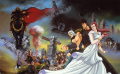
-
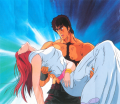
-
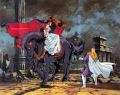
-
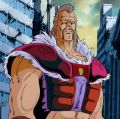 va Banjō Ginga
 -
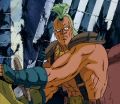
-
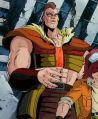 va Yasuo Tanaka
 -
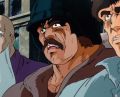
-
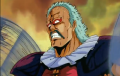 va Yūsaku Yara
 -
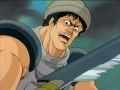 va Kōzō Shioya
 -
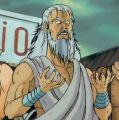
-
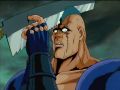
-
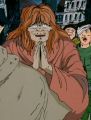 va Reiko Suzuki
 -
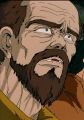 va Yasuo Tanaka
 -
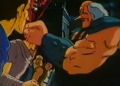 va Jōji Yanami
 -
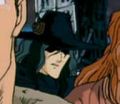
-
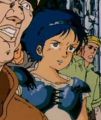


References
[edit | edit source]- ↑ "Hokuto no ken (1986)". Imdb.com. Retrieved on 2008-09-14.
- ↑ "「北斗の拳」で美しいと言えば… (Razor Sharp)".
- ↑ "【ジャンプ黄金期】1986年『第8号』2月3日号".
- ↑ "劇場版 北斗の拳のパンフレットを入手!! you は shock".
External links
[edit | edit source]- Hokuto no Ken (film) at Anime News Network's Encyclopedia
- Hokuto no Ken at the Internet Movie Database
- Official site of the 25th anniversary DVD release by Toei (Japanese)